Why understanding emergency gas, risk assessment and the purpose of a safety procedure matters more than blindly following it.
A safety measure is only useful if it works when you need it
Diving training organisations teach instructors and students about the use of a drop tank during deeper dives. The principle is straightforward: a cylinder suspended at approximately five metres provides an additional gas supply should a diver experience a gas shortage and need to complete a safety stop.
The intention is good. We should all support sensible precautions that improve diver safety.
But there is a question we should ask ourselves before considering this procedure sufficient:
Can a diver actually reach that extra gas supply when they need it?
Unfortunately, this question is often not asked. It is easier to focus on what a standard tells us to do rather than to understand why the procedure exists, what problem it is adressing, and under which conditions it will actually work.
And that is where a well-intentioned safety measure can become a potential safety hazard.
Think about the environment in which we dive
Let’s consider a typical boat dive in the open ocean.
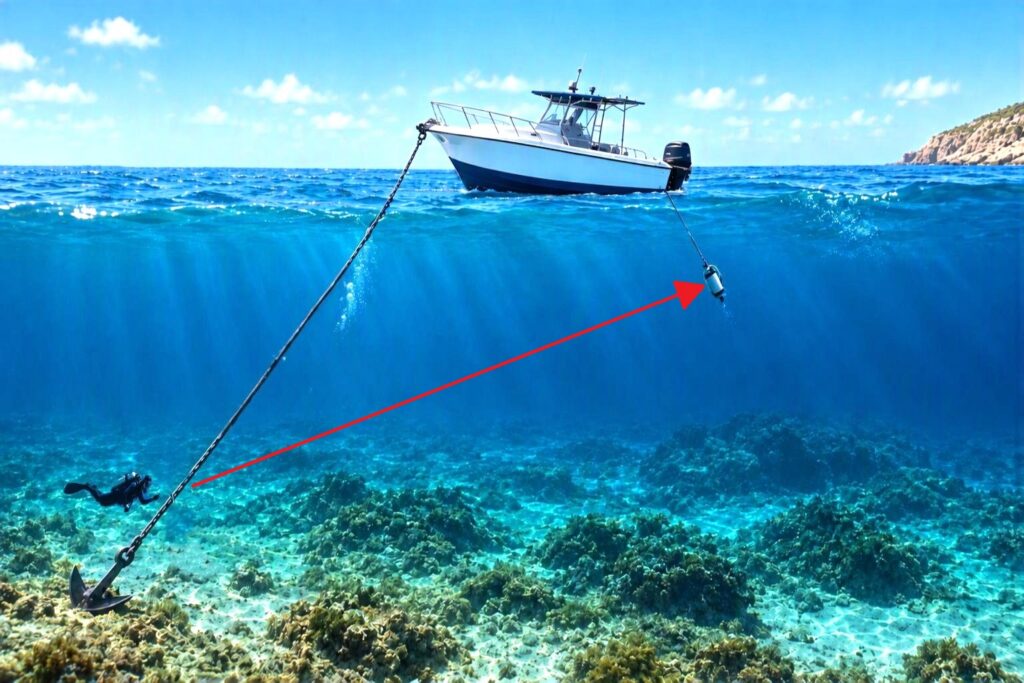
The boat is anchored at or close to the dive site. Because of wind and current, however, the boat does not necessarily sit directly above the anchor. The anchor line runs at an angle, and the boat lies some distance away from the actual anchoring point.
Now add a drop tank hanging from the boat at five metres.
The current pushes the boat and the suspended cylinder in the direction of the drift. The anchor keeps the boat attached to the seabed. The boat, anchor line and drop tank do not necessarily remain vertically aligned with the dive site.
Meanwhile, divers are exploring the reef, wreck or other underwater feature.
Imagine that one of those divers has a gas problem. He needs additional gas to complete the ascent and safety stop.
Where is the drop tank?
It is hanging beneath the boat, potentially some distance away from the diver and the dive site. It is possibly being pushed even farther away by the current.
Ask yourself an important question: if you were that diver, could you reliably reach the drop tank when you needed it?
The answer depends on the actual conditions. In some circumstances, the cylinder might be accessible. In others, reaching it could be difficult, impractical or impossible.
The critical point is that having a cylinder on the boat does not mean that the diver has access to that cylinder underwater.
Why do we continue to do it?
This brings us to a broader problem in diving education.
We teach standards, procedures and instruct students to follow established practices. All of this is necessary, particularly when developing consistent habits and managing risk.
But do we always teach the reasoning behind those procedures?
A checklist can confirm that a drop tank is present. It cannot confirm that the tank is accessible from every part of the dive site, that its gas supply is appropriate for the emergency, or that the team knows how to use it effectively.
When instructors, guides or boat staff follow a procedure simply because it appears in a training standard, without evaluating its suitability for the conditions, they may unintentionally create a false sense of security.
The instructor believes the necessary precaution has been taken. The student sees the cylinder and assumes that emergency gas has been provided for.
Yet the fundamental question remains unanswered: will the solution work when it matters?
This is not an argument against standards. Standards provide an important foundation for safe diving. It is an argument for understanding their purpose and applying them intelligently.
A safety procedure should be the result of risk assessment, not a substitute for it.
The same problem exists with gas reserves
The drop tank is only one example of a wider issue: the difference between following a rule and understanding the risk behind it.
The 100-bar rule
Consider another familiar instruction that many divers learn during their initial training: turn the dive with at half tank (100 bar) and return to the surface with a reserve (50 bar).
A simple, fixed reserve is easy to remember. It gives divers a clear reference point and can be useful as part of a broader gas-management plan.
But does 100 bar always provide enough gas to deal with an emergency?
Is 100 bar enough in case of emergency?
Consider a gas-sharing emergency at 30 metres. One diver can no longer breathe from their own cylinder, and both divers must ascend using the gas supply of the other diver.
At that depth, the ambient pressure is approximately four times surface pressure. Both divers may be breathing considerably more heavily than normal because of exertion, anxiety or stress. They need to resolve the immediate problem (1), establish a stable ascent (2), manage their buoyancy (3) and continue breathing throughout the ascent (4).
If a three-minute safety stop is planned it requires extra gas. The deeper part of the ascent is particularly demanding because each breath uses more gas when expressed as its surface-equivalent volume.
The amount required depends on several variables: depth, cylinder size, breathing rates under stress, the time needed to resolve the problem, ascent rate and any stops that must be completed.
A fixed reserve pressure cannot account for all those variables.
Hunderd bar is a pressure reading, not a guarantee that two divers have enough gas to complete an emergency ascent.
Depending on the dive and the assumptions used in the calculation, the gas needed for a controlled, gas-sharing ascent may be substantially greater than 50 bar in a typical recreational cylinder.
Plan for the unexpected
This is why gas-planning methods such as minimum gas or rock bottom are valuable. They work backwards from a defined emergency scenario to estimate the gas that must remain available to manage the problem and complete the planned ascent.
The resulting reserve is specific to the assumptions and equipment used. It is not a universal number, and the calculation must include appropriate allowances for the actual dive.
The lesson is the same as with the drop tank: we need to understand what the safety measure is supposed to achieve, rather than assume that following a familiar rule automatically makes us safe.
Availability is not the same as adequacy
These two examples reveal two separate questions that every diver should learn to ask.
First, is the emergency resource actually available when I need it?
A drop tank beneath a boat may contain plenty of gas, but that gas is of little practical use if the diver cannot reach the cylinder.
Second, is the available gas supply sufficient for the emergency I am planning for?
A cylinder may be immediately accessible, but its remaining pressure may not provide enough gas for two divers to resolve a problem and ascend safely.
Both questions matter. Solving only one does not solve the other. We need to consider all options:
- the location of the emergency resource
- the conditions in which it might be used
- the amount of gas available
- the actions the divers will need to take
This is what practical risk assessment looks like. It means considering the actual dive rather than assuming that a procedure developed for general use will be adequate in every situation.
How do we approach this at Scuba Sur?
At Scuba Sur, we believe students should understand both the purpose of a safety measure and its limitations.
We explain why a drop tank is used. We clarify what it’s intention is and why a cylinder suspended beneath a boat may not be the most effective solution in every open-ocean environment.
For appropriate dives, we use a dedicated bailout cylinder taken down to the dive site.
Typically, this is a seven-litre aluminium cylinder with its own regulator and a long hose. Its purpose is to provide an additional, independent gas supply positioned where it can be useful, rather than relying exclusively on a cylinder suspended beneath the boat.
Depending on the group size, dive plan and conditions, the bailout cylinder remains at a designated location near the anchor or a member of the team carries it. All divers are briefed on its location and the procedure for accessing it.
The equipment and its deployment must be appropriate for the dive, including the current, expected gas requirements and the team’s training.
Our approach does not stop at placing a cylinder underwater. We also explain how the equipment fits into the emergency plan and how divers should respond if a gas problem occurs.
The equipment must be supported by a procedure
The buddy remains the first consideration in an appropriate gas-sharing emergency. Divers must know how to establish gas sharing, reach the designated bailout supply when required, and use it according to the procedure they have practised.
The cylinder’s capacity must also be appropriate for the planned emergency. A seven-litre cylinder filled to 200 bar contains a nominal 1,400 litres of gas expressed at surface pressure and is sufficient to bring a diver that runs out of air safely back to the surface.
The objective is not to promise that one cylinder will solve every possible emergency. It is to plan a practical additional layer of protection that takes the dive environment into account.
Teaching divers to think, not just to follow
Our approach also forms part of the learning process for divers undertaking deeper-dive training.
The training
On shallower training dives, where conditions and the training plan allow, students learn how to work with the bailout cylinder and understand its role in emergency gas management.
They learn where the cylinder is located, how to access it and how the procedure fits into their response to a gas problem.
But we also want them to understand the reasoning behind the procedure. Why is the cylinder placed there? How to react if the current changes? How much gas do you need if two divers must share? Does the planned reserve reflect the depth and the actual equipment being used?
The purpose
These are not unnecessary complications. They are the questions that turn a memorised procedure into an understood safety system.
As divers progress and begin undertaking deeper dives without direct supervision from a dive centre, this understanding becomes increasingly important.
They need to think about their gas supply, their buddy, the dive environment, their ascent options and the resources actually available to them.
A safety measure that works in one environment may be inadequate in another. Recognising that difference is part of becoming a competent, independent diver.
The real lesson
The debate about these topics is only one example of a much larger issue in diving safety.
We should not measure safety by the number of procedures we follow or the amount of equipment we carry. We should evaluate whether those procedures and equipment actually reduce the risks we face.
A drop tank can be useful when it is accessible and appropriate to the dive. A fixed gas reserve can provide a useful reference point within a sound gas-management plan. Neither should be treated as proof of safety without considering the circumstances in which it must work.
The same principle applies to every safety measure we teach.
Understand the problem. Evaluate the environment. Calculate the requirements. Choose a solution that addresses the actual risk. Make sure the divers understand both how it works and where its limitations lie.
Because the ultimate objective of diving education is not to produce divers who can follow a checklist.
It is to produce divers who understand why they are doing what they do — and who can think clearly when conditions do not go according to plan.