Finding Your Balance Underwater
Most divers are taught that good buoyancy and trim are important.
They are told to remain horizontal, avoid moving their hands, control their breathing and use their BCD to adjust their buoyancy.
All of that is true. But it doesn’t necessarily explain how to actually achieve it.
Many divers can spend hundreds of hours underwater and still find themselves swimming slightly feet-down, constantly adjusting their BCD, or making subtle movements with their legs and arms to maintain their position.
Perhaps the problem is not a lack of practice.
Perhaps they have simply never been given a good mental model of what they are trying to control.
The game of balance
I like to look at buoyancy and trim as a game of finding and controlling a virtual point of balance.
Remember learning to walk
Think about a young child learning to walk. At first, the child falls frequently. Eventually, they discover something fundamental: in order to remain upright, their balance point needs to remain between their feet.
This is called balance.
The important difference is that the child is standing on something solid. The floor provides a fixed reference point. A diver doesn’t have that luxury.
Underwater, there is no floor. Your body is suspended in three dimensions.
Instead of balancing on a physical point, you’re effectively balancing around a virtual point that exists within the combined system of your body and equipment.
Let’s call this the virtual point of balance.
And unlike a child standing on the ground, you, as a diver, have to move that point. That is the key.
Instead of asking: “How much air do I need?”, ask “Where is the air in my BCD?”
Where is your virtual point of balance?
Consider a typical diver entering the water.
A significant part of the diver’s negative weight is concentrated around the waist, hips and cylinder. To offset that weight, air is added to the BCD. But the air doesn’t simply disappear into the BCD, it moves. Like anything less dense than water, it naturally migrates to the highest point available: the top of the BCD.
If the diver is upright, much of that air will collect around the shoulder area of the BCD. At the same time, the weights are pulling the lower part of the diver down.
The result is predictable: the diver becomes feet-heavy.
The usual reaction is often to add or remove air from the BCD, or to kick harder to compensate.
But there is a better question to ask. Instead of asking: “How much air do I need?”, ask “Where is the air in my BCD?”
That question is often far more useful.
Move the air, not just the diver
Try this in the water.
Stretch your body out and briefly point your head slightly down while allowing your feet to come up. You will notice the air in your BCD will move from the shoulder part to your hips.
As you change the orientation of your body, the highest point inside the BCD changes. The air follows it.
With the right body position, the air can move towards the lower part of the BCD, roughly around the kidney area. And where are your weights? Very close to that same area.
Suddenly, the two forces are much better balanced.
You haven’t necessarily added or removed any air. You have simply changed where the air is located. This is one of the most important concepts in understanding trim.
The BCD is not just an air container. It is a container in which the position of the air matters. Nature will always try to put the air at the highest point. Your job is to decide where that highest point should be.
Finding the balance front to back
Once you understand this, trim becomes much more like a balancing exercise.
If your feet remain heavy, the virtual balance point is too far toward your head.
Think about it. If you are feet heavy, the balance point is too close to your head and as a result you tilt head up feet down. In order to establish the balance, you must move the point closer to your feet so the tilting is in balance. Small adjustments can have surprisingly large effects.
- Lifting your shoulders slightly may raise the cylinder and shift the balance back toward the centre.
- Stretching your arms forward can have a similar effect.
- Even bending your knees changes how weight is distributed.
This is a practical example of the lever-arm principle: a relatively small movement at one end of your body can produce a noticeable change in balance.
If, on the other hand, you are too heavy at the head end, you need to work in the opposite direction.
- Lowering your shoulders can bring the cylinder down slightly.
- In some situations, moving your arms behind you may be more effective than extending them forward.
The goal isn’t to memorise a specific set of corrections. The goal is to understand the underlying principle: move the mass until the system finds its balance.
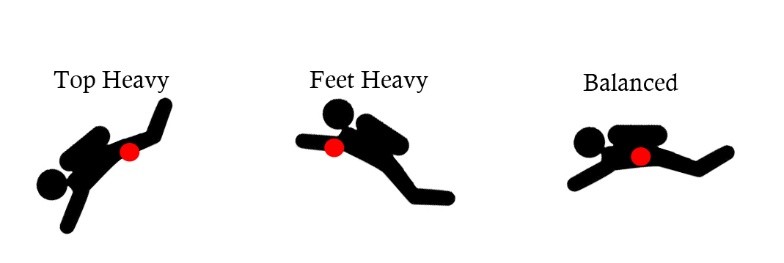
Once you understand that, you can experiment and discover what works for your own equipment configuration and body shape.
What if you are leaning to one side?
The same concept applies laterally.
Suppose you are slightly tilted to the left. Rather than fighting the position with your fins, try moving your right shoulder slightly forward.
This changes the position of your cylinder and therefore changes the distribution of weight around your body.
If you are leaning to the right, try the opposite.
The movements are small.
The objective is simply to make small changes to the position of the system until it finds its natural balance.
With practice, you stop consciously thinking about it. You simply do it.
That’s when trim becomes a skill rather than an exercise.
Pay attention: “Small changes ofter have a huge impact in your balance!”
Your lungs are part of your buoyancy system
Another aspect of buoyancy control is often underestimated: your lungs.
Most diving instruction correctly teaches that breathing affects buoyancy.
The usual explanation is: “Breathe in and you become more buoyant. Breathe out and you become less buoyant.”
That is true, but it doesn’t tell the whole story.
- Your lungs have a considerable volume.
- Try a simple experiment.
- Put your hands on your chest and breathe normally.
- Notice how little your chest moves.
- Now take a deep breath.
- Your chest expands considerably.
The difference in volume between those two states represents a significant change in displacement and, therefore, a meaningful change in buoyancy.
Learning to use that extra volume
This is an exercise I often use with divers.
Then take a deeper breath and allow your chest to expand.
Now, without holding your breath, return to your normal breathing rhythm while maintaining some of that additional volume.
At first, it may feel unusual, or even slightly uncomfortable. That’s normal.
The purpose isn’t to dive with permanently full lungs. The purpose is to discover that your lungs are another buoyancy-control mechanism available to you.
Once you’re comfortable using it, a small change in lung volume may be enough to keep you clear of the bottom without touching your BCD.
- Adding or removing a small amount of air from your BCD is a relatively slow and coarse adjustment.
- Changing lung volume gives you a much more immediate and fine adjustment.
Think of your BCD as the coarse adjustment and your lungs as the fine adjustment. And this is not breath-holding. You should always maintain a continuous breathing pattern. The exercise is about learning to control your comfortable lung volume, not about holding your breath.
Don’t expect an immediate response
One final aspect of buoyancy control is often overlooked: time. When you change your buoyancy or balance, the result is not necessarily visible immediately.
How quickly the system reacts depends on your equipment, body position, depth, and the body of water.
A change can take several seconds before its full effect becomes apparent.
This creates a common problem.
- A diver adds some air to the BCD.
- Nothing seems to happen.
- So, they add some more.
- Still nothing.
- They add another little burst.
- And suddenly they are too buoyant.
The same thing happens in reverse when removing air.
The solution is not necessarily to become faster with the controls, it is to learn to anticipate.
- Make an adjustment.
- Wait.
- Observe.
Then decide whether another adjustment is needed.
Good buoyancy control is therefore not simply about controlling buoyancy. It is about understanding how the entire system responds to your inputs.
Eventually, you stop thinking about it
At first, all of this may sound complicated.
- Where is the air?
- Where is the weight?
- Where is my balance point?
- Should I move my shoulders?
- My cylinder?
- My arms?
- My knees?
- Should I change my lung volume?
But this is exactly how every physical skill begins.
A child learning to walk has to consciously discover balance.
An experienced walker doesn’t think about it anymore.
The same thing can happen underwater.
- Eventually, you feel that you are slightly feet-heavy before you consciously analyse why.
- You make a small adjustment.
- You feel yourself becoming more stable.
- You change your lung volume slightly.
- You wait for the response.
- You adjust again.
And eventually, it becomes automatic.
You are no longer “trying to maintain trim”, you are simply balanced.
That, to me, is the real objective of buoyancy and trim training.
Not learning to look horizontal because an instructor says you should, but understanding the forces acting on your body, learning how to influence them, and eventually developing the ability to find and maintain balance without even thinking about it.
The comntent of this article is not dictated by any dive association. It is based on personal experience in diving and over a decade of teaching and coaching divers. If you should have comments aor questions, feel free to contact us.